
How Commercial Air Fresheners Work for Toronto Businesses

Walk into a hotel lobby, car showroom or boutique changing room and the first thing that registers often isn’t what you see, it is what you smell whether you realize it or not. Scent marketing in Toronto is becoming an essential way for retailers, hotels, offices and service businesses to shape the customer experience through fragrance.
Visual branding which includes the use of signage, color and layout plays a significant role in marketing. Smell however, is an invisible force reaching people well before a logo or display is even processed. This guide explains scent marketing, its function, its application and how to create a plan for your business.
Scent marketing is the deliberate use of fragrance in a commercial space to support a business’s brand and shape the customer experience. It differs from simply making a room smell nice. A scent marketing programme selects a fragrance based on what a brand wants to communicate then distributes it consistently through commercial equipment built for that purpose.
For a retailer, that might mean a fragrance reinforcing a premium position. For a spa, something that supports calm. For an office, something clean and unobtrusive, working alongside interior design rather than as a separate decision.
Consistency matters too. A fragrance that appears occasionally, or changes without a plan, does not build the same association as one that shows up the same way every visit.
Factor | Regular air freshening | Scent marketing |
Purpose | Cover odours | Support brand and atmosphere |
Fragrance selection | Generic, seasonal | Matched to brand identity |
Consistency | Inconsistent | Maintained on a schedule |
Distribution | Plug-in units, sprays | Commercial scent diffuser or HVAC scent diffuser |
An air freshener solves a smell problem, that’s it. Scent marketing is a design decision, planned alongside the rest of a business’s physical environment, not bolted on afterward.
A signature scent is a fragrance developed or chosen to represent a particular business, much like a logo or color palette, rather than representing a generic category such as fresh laundry. One usually includes testing fragrance families against the brand’s identity before settling on a formulation used across locations.
Smell has a particularly interesting relationship with memory and emotion. A familiar scent can sometimes bring a place or experience to mind almost instantly.
Businesses can use that connection as part of the environment they create.
Smell is processed differently than the other senses. The olfactory system has a direct link to the brain’s limbic system, the part of the brain associated with memory and emotion. That’s why a scent can evoke a memory faster than an image or sound can. A smell that is encountered again and again in the same environment is associated with that environment and then with the business itself.
An appropriate fragrance can shape how customers perceive a space before they consciously evaluate anything else. A clean understated scent in a spa can support relaxation. A fresh scent near a fitting room can support a perception of cleanliness. A warmer fragrance in a boutique hotel lobby can support quiet luxury.
It doesn’t have the same recognition as a scent that is held at a consistent level, but a scent that changes from week to week or fades and then grows stronger depending on who last touched the diffuser. Even if they can’t put their finger on what’s wrong, customers sense inconsistency.
There are a handful of practical benefits once a programme is set up properly and maintained.
Most people don’t analyse every detail of a business they visit. Instead, they come away with an overall impression.
Was it comfortable? Did it feel polished? Would they want to return?
Fragrance adds another layer to that impression. When it fits naturally with the space, it can make the overall experience feel more distinctive.
Fragrance can complement visual branding, interior design and brand personality, reinforcing the same message customers already pick up from decor and staff interaction.
This repeated exposure will allow the customer to connect the odor with the visit to that particular business. Just smell the same odor again at another place after many years, and your business will be instantly remembered.
The right fragrance, at the right intensity, supports a space that feels welcoming, fresh or comfortable, and a premium retailer and a neighbourhood gym are chasing different feelings.
Businesses with several locations already try to keep their visual identity and service standards consistent. Fragrance can be managed in a similar way. A recognizable scent programme can help stores, offices, hotels, or other locations share a common sensory identity, even when the individual properties aren’t identical.
Not every business needs the same approach. In practice there are several ways to work fragrance into a customer experience.
Ambient scenting is probably the simplest concept. A subtle fragrance is distributed through a selected area to support its overall atmosphere. The scent isn’t tied to one particular product. It becomes part of the environment itself. It can be quite effective in lobbies, shopping malls, offices, showrooms and hospitality areas.
Scent branding goes a step further by establishing a fragrance strongly associated with a company’s identity. The aim is to create a consistent and recognizable scent experience customers can associate with the brand.
Thematic scenting is conducted with the help of scents that are compatible with a certain season, festive occasion, marketing strategy or event. For instance, a company can change its scenting strategy depending on the season but maintain one that complements its brand overall.
Scent can also work in combination with lighting, music, interior design, displays and other sensory elements. When all these are consistent in creating the same personality of the brand, it becomes more coherent.
Almost any customer facing environment could potentially use scent but that doesn’t mean every business should use it in exactly the same way. The setting matters.
Retailers can use fragrance at the entrance, shopping areas, fitting rooms or other areas of choice. A fashion boutique, for example, might want a scent that supports its brand personality without taking the customer’s focus away from the products themselves.
Hospitality businesses have several natural scenting areas, including lobbies, corridors, spas and selected guest spaces. Because the lobby often creates the first impression it can be an especially important part of a hotel’s fragrance experience.
Reception areas, customer-facing spaces, meeting areas and common spaces can benefit from subtle commercial scenting when it aligns with the workplace environment.
Showrooms often rely heavily on presentation and atmosphere. A carefully selected scent can complement polished interiors and contribute another sensory element to the customer experience.
Lobbies, reception desks and shared amenity spaces benefit from a consistent fragrance that signals the common areas are actually looked after.
Gyms, studios, spas and salons deal with odour from equipment and treatments as a matter of course and fragrance helps manage that.
Creating a consistent fragrance experience across a commercial environment generally requires more control than household fragrance products can provide.
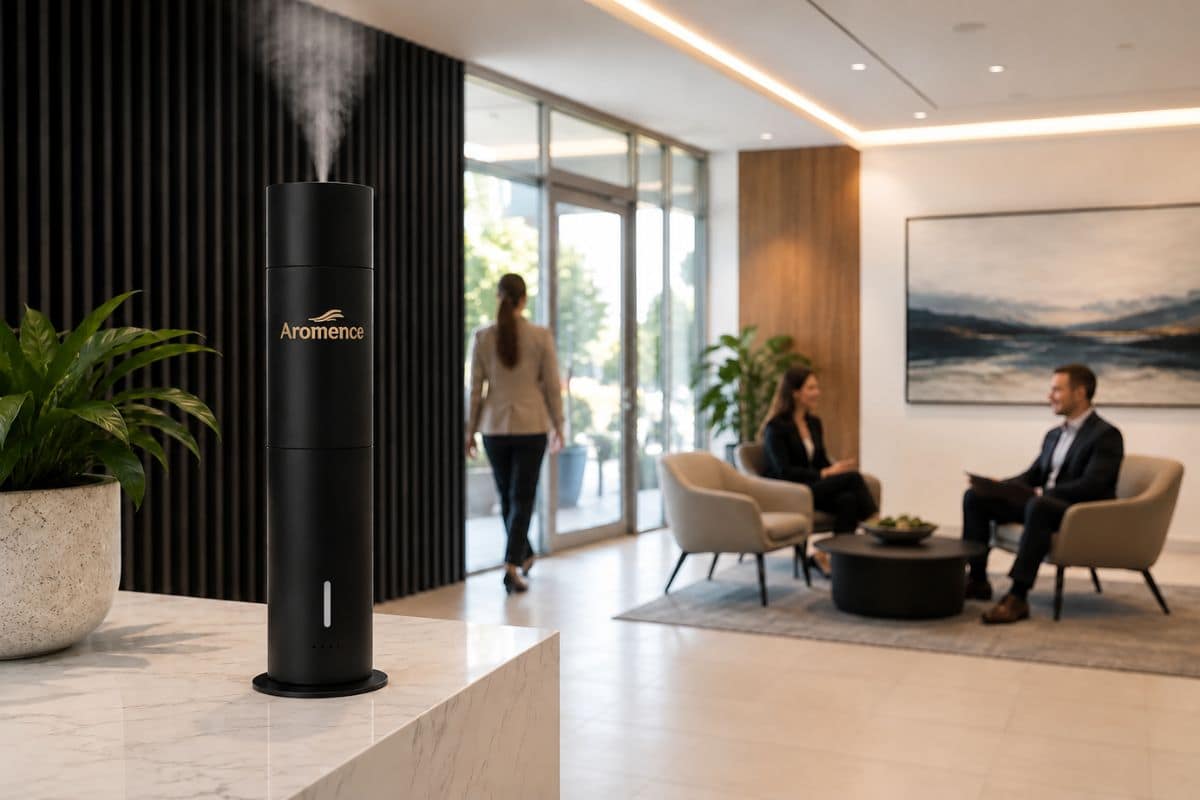
A commercial scent diffuser is built to distribute fragrance across business environments with greater control over coverage, scheduling, and intensity. The appropriate system depends largely on the size and layout of the property. A small reception area and a large showroom clearly don’t have the same requirements.
Many commercial systems use cold-air diffusion. In simple terms, a commercial scent machine breaks fragrance oil into very fine particles and disperses them into the air. This makes controlled distribution possible without relying on an occasional burst from a spray.
For businesses, that control is useful because the goal is consistency throughout operating hours.
Fewer walls means fragrance has fewer barriers to work around, which sounds good until it means the scent thins out faster than expected. Air movement and diffuser placement end up mattering more than in a home with separate closed rooms.
Standalone units sit directly in a space and cover a defined area on their own. Good for smaller footprints, or a specific zone like a reception desk, rather than an entire building.
An HVAC scent diffuser connects into a building’s heating and cooling system and pushes fragrance through the existing ductwork, covering larger or multi-room spaces from one connection point, depending on equipment compatibility.
Many commercial systems allow scheduling by operating hours, intensity adjustment by zone, and remote management. No one needs to walk over to a unit just to turn it down.
Choosing a fragrance is actually somewhere in the middle of the process—not the beginning.
A stronger strategy starts with understanding what you’re trying to achieve.
Start with the business goal. Perhaps the reception area feels a little anonymous and you want it to feel more welcoming. Maybe you’re building a recognizable sensory identity across several stores. Or perhaps the objective is simply to make the overall customer environment feel more polished. Knowing the goal prevents fragrance selection from becoming guesswork.
Fragrance decisions should follow the target audience, not just what the owner personally likes. A spa serving clients who want calm has different needs than a fast-paced retail floor.
Fragrance families each carry a different feel. Citrus reads fresh and energetic, woody grounded, floral soft, gourmand warm. Fresh and clean profiles tend to work broadly. Either way, the choice should come from brand identity, not from what smells nice to one person in a meeting.
You may not need to scent the entire building. Look at the customer journey. The entrance, reception area, showroom, waiting space, or main shopping area may have more impact than a back corridor customers barely use. Prioritizing the right zones can also make the programme easier to manage.
Square footage is important, but don’t stop there. Ceiling height, layout, airflow, ventilation, operating hours, and the number of scenting zones can all affect the system you need. This is one reason professional commercial scent marketing is different from putting a small diffuser in a room and hoping for even coverage.
A common temptation is to think that if a little fragrance is good, more must be better. It isn’t. In many commercial environments, the best scent is one customers notice naturally rather than one that announces itself the moment the door opens.
The first settings don’t have to be the final settings. See how the fragrance performs during busy and quiet periods. Listen to staff and customer feedback. Check consumption and equipment performance. Small adjustments can make a big difference.
Even an excellent fragrance can deliver a poor experience when the strategy behind it is wrong.
Your favourite fragrance may not represent your brand or appeal to the environment you’re creating. Start with your customers and brand positioning.
Stronger isn’t better. Overly intense fragrance tends to feel overwhelming and works against the atmosphere the business was going for.
Fragrance needs to be consistent with the image that the consumer is getting from other sources. A disconnect between the fragrance, look, product and positioning is possible.
A unit sized for a small office won’t touch an open retail floor. One sized for a large space, dropped into a small room, will overwhelm it.
Residential units are built for a single room in a home. They don’t have the coverage a commercial floor plan needs, no matter how many you cram in.
Refills, maintenance, the occasional intensity check. Skip it long enough and the system quietly drifts from whatever it was originally set to.
Businesses all across Toronto and the GTA may change scent through the year, a lighter one during spring and summer and a warmer one in autumn and winter for example. But, it is essential to keep in mind that the change should be somehow related to the current brand.
A fragrance should be maintained in such a way that it is pleasant for the clients as well as the employees but should never be overpowering in a shared environment. Good positioning, in particular avoiding areas where there are crowds of people close together, is very helpful.
Setting a programme up properly means a site assessment, correct diffuser placement, installation and ongoing fragrance replenishment and maintenance. Aromence provides scent marketing in Toronto and across the GTA, helping businesses create a consistent fragrance experience that suits their space and brand.
There isn’t one price that fits every business. A small boutique with one scenting area will naturally have different requirements from a large commercial property with several zones. Professional commercial scenting services are typically priced according to the space, equipment and ongoing fragrance requirements.
Aromence offers three starting plan levels for different space requirements:
Plan | Best for | Starting price (CAD) |
Essential | Small spaces | From $149/month |
Professional | Medium spaces | From $249/month |
Commercial | Large spaces | From $449/month |
These are starting rates. Final pricing can vary depending on the space and scenting requirements.
A small boutique or single office typically fits an entry-level plan with one or two zones. A larger retail floor or multi-room office usually needs a mid-tier plan, and a large commercial space or HVAC-based installation generally falls into a higher tier. The right fit depends on square footage and zone count more than price alone.
A fragrance can be excellent, but poor placement or inconsistent delivery can still undermine the experience.
That’s why the provider matters.
A provider with real commercial scenting experience knows the difference between a residential air freshener and a system built for continuous, controlled operation.
Look for a provider offering fragrance and equipment matched to different industries, room sizes and coverage needs, rather than one size handed to every client regardless of fit.
A complete service covers site assessment, installation, fragrance replenishment and technical support. Not just a box dropped off at the door.
Aromence works with businesses across Toronto and the GTA, handling site assessment, installation and ongoing service for commercial scent marketing programmes.
Effective scent marketing comes down to a few decisions made correctly: the right fragrance, appropriate intensity, technology matched to the space and placement that reaches the areas customers actually experience. It does not work as a one-time setup; it needs periodic review, the same as any other part of a business’s physical environment.
For a retailer, hotel, office, showroom or wellness business looking to make its space more distinctive, scent marketing offers a way to do that consistently.
Looking to introduce scent marketing in Toronto or the GTA? Talk with Aromence about a commercial scent solution designed around your space, brand and customer experience.
Yes. A small boutique, salon, studio or office can use scent marketing without a large commercial programme. A single standalone diffuser covering an entrance or reception area can support the same goals as a larger system, scaled to the space.
Timelines vary based on the business's goals, the space and installation requirements. A single-location setup with a standalone diffuser moves quickly, while signature scent development or a multi-location HVAC installation takes longer.
Many use both. A signature scent provides a consistent brand association year-round, while seasonal scents around holidays or campaigns add variety without replacing the core identity.
Yes, with attention to consistency. Maintaining the same fragrance across locations requires accounting for differences in square footage, layout and airflow, so a setting that works at one site may need adjustment at another.
Certain commercial systems are designed to distribute fragrance through a building's HVAC infrastructure, depending on the equipment and setup. A site assessment confirms whether this is an option for a specific building.
Create unforgettable atmospheres. Elevate every moment with the power of scent. Let’s bring your space to life.


