
How Commercial Air Fresheners Work for Toronto Businesses
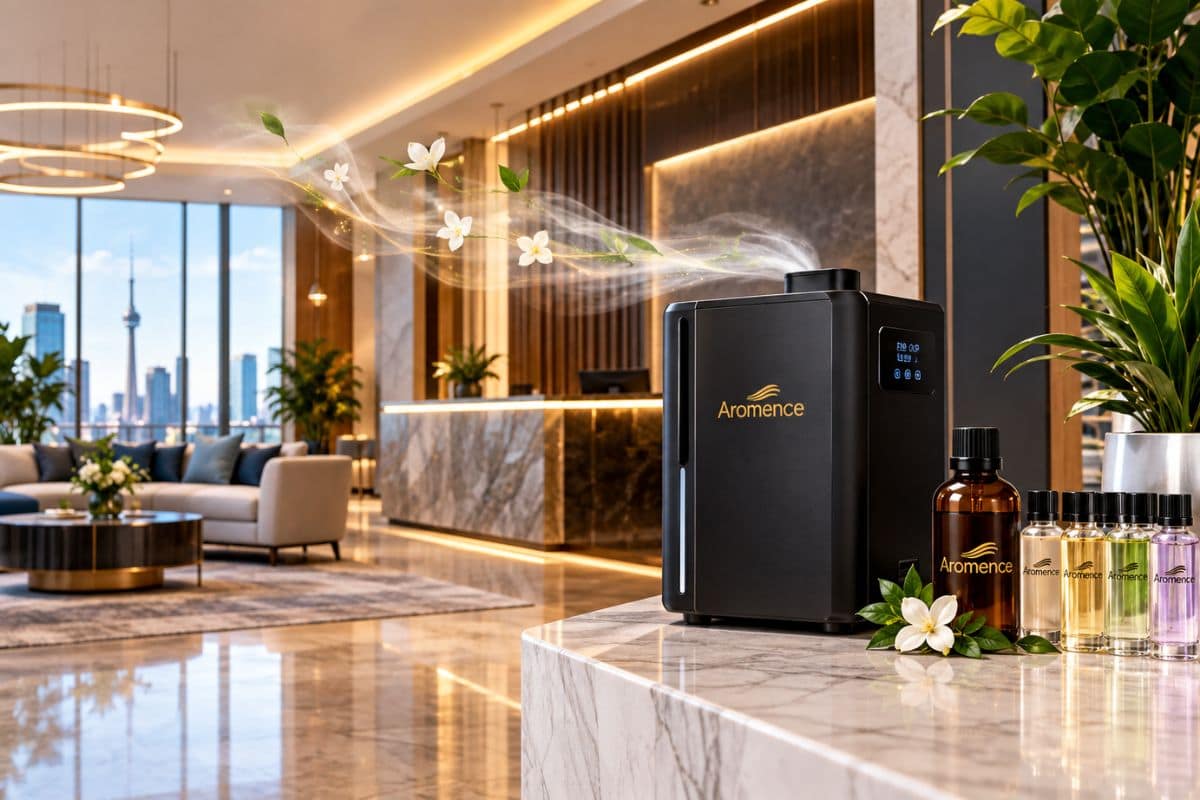
Walk into a well-designed business and you notice the details almost immediately. The lighting feels considered, the layout makes sense and the music suits the setting—and increasingly, commercial fragrance systems are becoming part of that carefully planned experience.
For businesses in Toronto and the GTA, choosing the best commercial fragrance systems involves more than finding a scent that smells pleasant. Coverage, equipment, control, installation and maintenance all influence how well a fragrance system performs in a professional environment. Unlike plug-ins or air fresheners sprayed manually, commercial scenting systems are specifically manufactured to deliver a consistent level of fragrance in professional settings.
But what’s good for a small boutique might not be the right setup for a busy hotel lobby or a large showroom. This guide covers the different commercial scenting options, what to consider before choosing one and how to find a system that works for your business.
Commercial fragrance systems are professional scenting solutions designed for business environments. Rather than relying on a strong fragrance source in one corner of a room, these systems are intended to create a more balanced scent across a defined area.
Many professional systems use cold-air diffusion, also known as nebulization. The technology breaks fragrance oil into a very fine, dry mist without relying on heat or water. Depending on the equipment and building, the fragrance can then be released directly into the room or introduced into compatible HVAC airflow for wider distribution.
Businesses can also alter the strength of the fragrance, select operating times and specify when scenting begins and ends.
The real difference comes down to control.
For a single office bathroom, none of this matters much. For a showroom floor, it does.
Toronto is a crowded business market. Retailers, hotels, offices, spas, property managers, dealerships, and service businesses are often competing for attention within the same neighbourhood, sometimes on the same street.
Price and service still matter, of course. But the physical environment also contributes to how customers experience a business.
Scent works alongside everything else a space is already doing. A boutique with a signature scent gives visitors something to associate with the brand. This is not a guarantee of selling more products; rather, it is a design choice, like choosing paint colors or music.
Manually spraying a room produces something strong right after application and gone an hour later. A programmed system holds a steady level through opening and closing hours. That matters more for businesses running multiple locations or several distinct areas under one roof, since a scent that varies between visits reads as inconsistent branding rather than intentional design.
Choosing a fragrance that fits the business, instead of one that’s simply strong or pleasant, ties scent into the same identity work as a logo or a colour palette. A spa and a car dealership shouldn’t smell the same, even if both want their space to feel considered.
This applies across retail units, hotels, condo lobbies, office towers and service businesses throughout Toronto and the GTA.
Commercial scenting can work in many environments, but the way it is used should change with the business.
A retail fragrance system can help maintain a consistent scent across customer-facing areas. Fragrances for boutiques, dealership or showroom environments can be incorporated into the design alongside lighting and other components.
Hospitality businesses often have several areas where atmosphere matters.
Commercial scenting may be suitable for:
Fragrance should be used with proper discretion. An aroma that is perfect in a large lobby could be too strong for use in a small reception area.
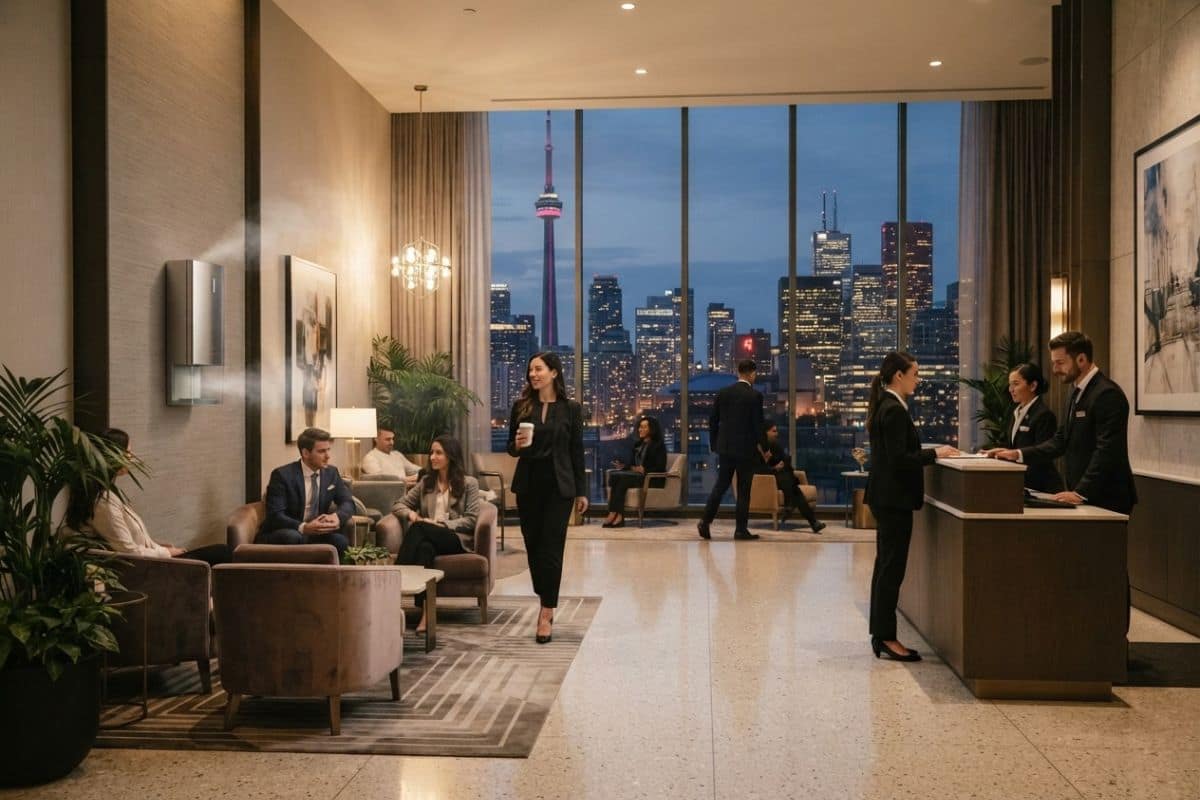
Offices may use scent differently from retail or hospitality businesses. An office scent machine can be considered for reception areas, entrance lobbies, shared spaces and client-facing rooms. Because employees may spend several hours in these environments, subtle fragrance levels are especially important.
Condominium common areas, fitness centres, dealerships, entertainment venues, property management spaces, and other customer-facing businesses may also use professional scenting.
Not every business needs the same type of fragrance equipment. The right choice depends on how the space is used, how air moves through it and whether the business wants to scent one area or several.
A small boutique may only require a stand-alone diffuser, whereas a larger property with compatible ventilation might benefit from an HVAC-connected configuration. Knowing what’s out there helps in choosing equipment that fits the property and not paying for features or coverage the business doesn’t need.
Standalone systems release fragrance directly into the surrounding area without requiring a connection to the building’s ventilation network. They can be a practical choice for boutiques, salons, offices and reception areas where coverage and placement are the main considerations.
HVAC-connected systems introduce fragrance into compatible ventilation airflow, allowing it to travel through the areas served by the system. This approach may suit hotels, large offices and multi-room properties, provided the existing ventilation infrastructure supports the installation.
Larger commercial spaces may require equipment with greater output and oil capacity. High-capacity fragrance machines can be considered for showrooms, large retail stores and open commercial spaces where smaller diffusers may struggle to maintain suitable coverage.
Wall-mounted systems can provide a more discreet installation for offices, boutiques and reception areas. Multi-unit configurations may be useful for divided spaces or properties with several fragrance zones where consistent distribution is important.
This is where a little planning can prevent an expensive mistake. A diffuser should not be selected only because its advertised coverage appears large enough. Square footage is important, but it does not tell the whole story.
Consider how the property actually works during a normal business day.
Important factors include:
Two Toronto businesses with identical floor areas may still require different systems. An open showroom, for instance, may allow fragrance to circulate relatively freely. An office of the same size could contain corridors, private rooms, meeting spaces, and closed doors that affect distribution.
A standalone commercial scent diffuser releases fragrance directly into a particular area. It can be a practical choice for a lobby, boutique, reception area, office, or other defined space.
An HVAC scent diffuser works differently. Where the building and equipment are compatible, fragrance can be introduced into the HVAC airflow and distributed through the areas served by the ventilation system.
HVAC scenting may make sense for certain larger spaces, but it is not automatically the better option. If a business only wants to scent its front reception area, installing a suitable standalone system may be far more practical. The building’s HVAC configuration should be assessed before deciding on an integrated setup.
Technical specifications matter, but day-to-day usability matters just as much.
Useful features may include:
An adjustable system that’s easy to maintain becomes much more valuable than one packed with unnecessary features.
Wall-mounted systems can provide a more discreet installation for offices, boutiques and reception areas. Multi-unit configurations may be useful for divided spaces or properties with several fragrance zones where consistent distribution is important.
There is no meaningful flat price for scenting every commercial space.
A small North York office, a downtown Toronto retail store, and a large GTA showroom may each require a different setup. Even properties with similar square footage can have different requirements because of their layouts and airflow.
Factors that can affect the overall cost include:
It is also worth looking beyond the initial equipment price. Fragrance is an ongoing operating cost and a system that is difficult to maintain or poorly matched to the space may prove less practical over time.
For a practical reference, Aromence offers commercial scenting plans starting at $149 per month, with professional and commercial options available for businesses requiring different setups.
Explore Aromence’s commercial fragrance systems to compare available scenting solutions, installation options and ongoing service plans for Toronto and GTA businesses.
Good equipment still needs the right setup. Before installation the provider should understand the layout of the space, where customers spend their time, how air moves through the property and the coverage the business wants to achieve.
A site assessment can help determine whether a standalone unit or another configuration makes the most sense.
For an HVAC-connected system the building’s ventilation setup also needs to be considered. Professional HVAC scenting relies on moving air to carry fragrance through the areas served by the ductwork so system configuration and operating schedules matter.
Before moving forward, business owners should also consider a few practical questions:
– Is the existing HVAC infrastructure compatible?
– Will the equipment require a dedicated installation location?
– Is landlord or property management approval needed?
– Who will handle fragrance refills and maintenance?
– Can fragrance intensity be adjusted after installation?
These details are easier to address before equipment is installed than afterwards.
A typical process may look something like this:
Site assessment → system selection → installation → programming → fragrance adjustment → testing
The final adjustment is easy to underestimate. A fragrance that seems too light during an empty-room test may feel much more noticeable once the space is occupied for several hours. Starting subtly and adjusting gradually is usually the more comfortable approach.
Once installed commercial scent equipment still requires routine attention.
Fragrance needs to be replenished, diffuser components should be kept clean according to the equipment requirements and system performance should be checked periodically. Operating schedules may also need adjusting as business hours or seasonal needs change.
A good scenting provider should ask questions before recommending equipment.
How large is the space? Where do customers spend most of their time? Is the floor plan open or divided? Does the business want one area scented or several? Is HVAC integration actually necessary?
Those questions matter because there is little value in installing more equipment than a business needs.
When comparing providers, consider:
Aromence works with Toronto and GTA businesses to match a fragrance system, scent and setup to the specific space, rather than selling a single standard package regardless of what the location actually needs. The company’s commercial scenting services cover site assessment through ongoing maintenance, so a business isn’t left managing the equipment alone after installation.
Good commercial scenting should not demand attention. In fact, when it is done well, most customers will probably never think about the equipment behind it. They simply experience a space that feels more considered.
For Toronto and GTA businesses, achieving that result starts with choosing a system around the property rather than trying to make the property fit a particular machine. Coverage, airflow, fragrance choice, intensity, operating schedules, and maintenance all deserve consideration.
If you are exploring commercial fragrance systems for your business, contact Aromence to discuss your space, scenting goals, and the type of setup that makes sense for your day-to-day environment.
Start with your property's size, layout, airflow and operating hours. Compare standalone and HVAC options, then consider fragrance intensity, installation requirements, maintenance and ongoing costs.
Yes. Commercial fragrance systems are not only intended for large hotels or shopping centres. Smaller systems can be suitable for boutiques, salons, clinics, offices, and reception areas. The important thing is matching the diffuser's coverage and output to the actual size and layout of the business.
There is no fixed timeframe because fragrance consumption depends on the system, intensity setting, operating schedule, and size of the space. A commercial scent diffuser running for limited business hours at a subtle setting will generally use oil differently from a system operating for longer periods in a large property.
It may be possible to connect an HVAC scent diffuser to an existing compatible ventilation system. However, commercial HVAC configurations vary considerably, so the property should be assessed before installation. A standalone diffuser may sometimes be the more practical choice.
Commercial scenting can be used in occupied workplaces, but fragrance sensitivity, ventilation, product instructions and exposure levels should be considered. Keep scent subtle and provide fragrance-free accommodations where needed.
Create unforgettable atmospheres. Elevate every moment with the power of scent. Let’s bring your space to life.


